


You have just hit stop on the recording button. The interview was perfect, the chemistry between you and your guest was effortless, and the insights shared during the past 45 minutes were pure gold. You export the multi-track audio, hand off the file for noise reduction or basic trimming, and feel a well-deserved wave of creative accomplishment.
Then reality sets in… Before you can publish the episode, you have to write the show notes.
For thousands of podcasters, this is the exact moment post-production inertia strikes. Sitting down in front of a blank document on a Sunday night, trying to scrub through an hour of audio to remember exact timestamps, track down guest social handles, format sponsor promo codes, and draft an SEO-friendly summary feels like running a marathon immediately after finishing a triathlon.
It is no surprise that writing show notes consistently ranks among the most dreaded tasks in the entire podcasting workflow.
However, treating show notes as an administrative afterthought is one of the biggest growth mistakes an audio creator can make. Beyond being a mere episode description, show notes serve as your primary web search engine, your audience retention hook, your accessibility bridge, and your strongest affiliate revenue driver.
The solution is not to work harder or spend more hours squinting at waveform timelines. The solution is to change how and when show notes are built. By shifting from manual post-production writing to a structured, template-driven system, you can transform a hours-long chore into a streamlined, 15-minute process.
Part 1: The Invisible Power of Podcast Show Notes
Why spend time polishing text when podcasting is an audio-first (or video-first) medium? The answer lies in how modern audiences consume content and how search engines index information online.
1. Organic Search Discoverability (SEO)
Audio files themselves cannot be crawled directly by search engine spiders in the same way written web copy can. When Google or other search engines index your episode webpage, they rely on readable text. As discussed in depth on the podcast episode exploring what relevance search engines have on podcast success, indexable copy is the single greatest bridge between passive searchers and active listeners.
Comprehensive show notes, replete with strategic keywords, structured headings, guest bios, and detailed topic breakdowns, give search engines the context necessary to rank your episode for specific niche queries. If a user searches for a specific problem your guest solved, thorough show notes guarantee your website appears in the top search engine result pages (SERPs).
2. Listener Navigation & Retention
Modern content consumption is nonlinear. Listeners often skim before they commit 45 minutes of their commuting or workout time to an audio track. Clear, clickable timestamps allow prospective listeners to jump straight to the topic that interests them most.
Counterintuitively, giving listeners a roadmap to skip ahead does not decrease overall play time; it reduces bounce rates. When listeners know exactly where the valuable takeaways reside, they are far more likely to stay engaged throughout the episode.
3. Monetization and Link Attribution
Whether you are promoting affiliate products, tracking sponsor conversions, or sending traffic to your own sales pages, show notes are your primary conversion engine. Expecting a listener to memorize a complex URL spoken aloud at the 34-minute mark is a recipe for missed revenue. Placing clean, trackable links directly in the episode notes converts audio mentions into measurable clicks. Strategies covered in scaling your podcast for growth and monetization, show that well-formatted show notes directly impact affiliate sales performance.
4. Accessibility and Inclusivity
Not everyone in your audience can listen to audio at all times. Some subscribers prefer reading quick summaries during noisy commutes, while others may be deaf or hard of hearing. Comprehensive show notes, accompanied by chapter markers and complete transcripts, ensure your content remains accessible to every potential audience member regardless of context or hearing ability.
Part 2: Diagnosing the Dread – Why Writing Show Notes Feels Hard
If show notes are so valuable, why do podcasters dread writing them so much?
To fix the process, it helps to understand where the friction originates. According to empirical data in The Podcast Time Audit, creators routinely lose hours each week to fragmented administrative tasks scattered across post-production.
| The Pain Point | Why It Happens | The Result |
| Blank Page Syndrome | Staring at an empty document with no fixed structure or starting outline. | Procrastination and decision fatigue. |
| Audio Scrubbing | Re-listening to raw audio files to locate specific quotes and exact timestamps. | Wasted time and severe context switching. |
| Email Ping-Pong | Chasing guests across email chains for headshots, bios, and social handles. | Missing details at launch time. |
| Post-Edit Fatigue | Writing copy at the very end of an already exhausting editing sprint. | Rushed, low-quality descriptions that harm SEO. |
When show notes are treated as a reactive task performed after the audio is finalized, every step requires maximum cognitive effort. The key to eliminating the dread is flipping the script: move show note creation from post-production reaction to pre-production preparation.
Part 3: 5 Strategies to Eliminate Show Notes Dread
1. Build Notes Before You Hit Record
The easiest way to write show notes is to write them before the interview even takes place. During your pre-production phase, draft a simple outline:
- What primary problem does this episode solve?
- What are 3 to 5 core questions or discussion blocks?
- What is the guest’s official bio and link list?
By structuring your prep document into clean bullet points, you create a dual-purpose artifact: an interview roadmap during recording, and 70% of your final show notes copy after recording.
2. Standardize with Modular Templates and Magic Tags
Stop re-inventing the wheel for every single episode. Establish a standardized show note template that remains consistent across your feed.
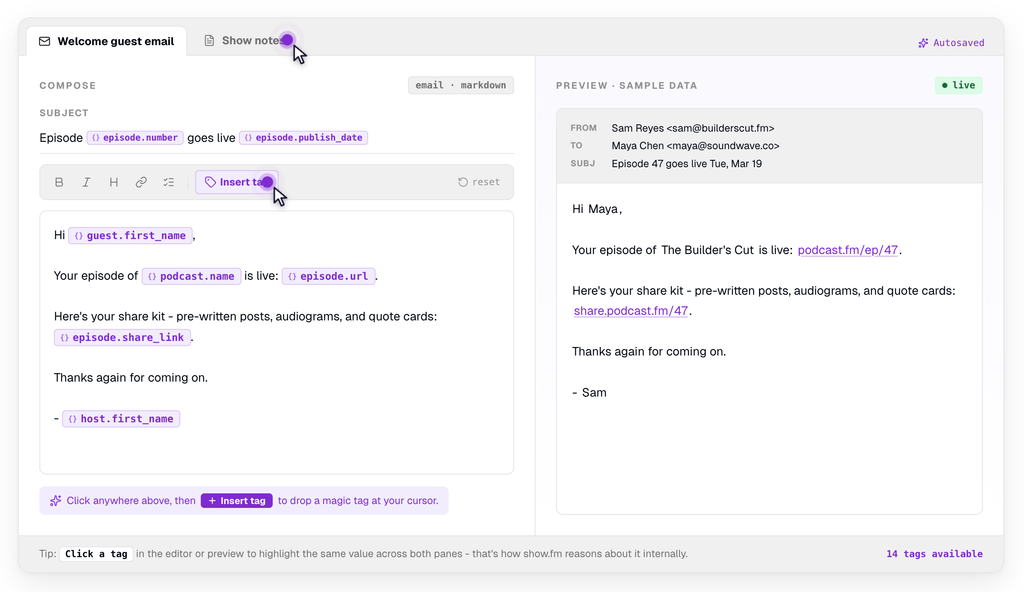
Using dynamic workflows, such as the reusable layouts and magic tags detailed in show.fm’s template system, allows you to maintain uniform visual structure without manual copying and pasting. Placeholders automatically populate fields like {{guest.name}}, {{episode.title}}, and {{guest.website}}, ensuring that your copy formatting stays flawless while taking seconds to generate.
Here’s an example of how you might use these tags in an email in show.fm, but they can also be used to auto-generate show notes for your episodes as well.
3. Use Transcript-Driven AI Summaries (Without Sacrificing Quality)
Writing from scratch is tedious, but editing pre-generated text is fast. Modern AI transcription tools can take raw episode audio and generate bulleted takeaways, topic summaries, and candidate timestamps in seconds.
To keep your show’s authentic brand voice intact, avoid publishing raw, unedited AI output. Instead, treat the AI output as a rough draft. Spend 5 to 10 minutes refining tone, polishing punchy bullet points, and checking link accuracy. As outlined in The Ultimate Guide to Starting a Podcast, combining AI transcript extraction with human editorial oversight gives you the best of both worlds: rapid speed and high creative quality.
4. Streamline Guest Onboarding
Chasing guests for bios and link details post-recording creates unnecessary bottlenecks. Instead, collect all necessary metadata upfront during the guest booking process.
When guests select an interview slot via your booking page, require them to submit their preferred bio, headshot URL, company website, and social handles. That information can automatically feed directly into your show notes document, completely eliminating post-record email follow-ups.
5. Consolidate Your Workspace into “One Doc, Three Lenses”
One major cause of post-production friction is tool switching. Hosts often keep prep notes in Notion, host audio on one platform, manage transcripts in another, and draft show notes in WordPress.
Adopting a unified workspace simplifies this process significantly. As featured in show.fm’s dedicated show notes tool, keeping host directions, guest information, and other information inside a single collaborative document prevents stray edits and keeps your team completely synchronized.
Part 4: The Perfect Show Notes Anatomy
To maximize both search rankings and listener engagement, every episode post should follow a structured visual hierarchy. Here is the anatomy of a high-converting, SEO-optimized show notes page:
- The Hook (First 2–3 Sentences): State clearly what problem this episode solves. Include your primary keyword naturally within the first two sentences to capture both search engine crawlers and scanning human eyes.
- Audio/Video Embed: Place an optimized, responsive audio player near the top of the page so visitors can hit play immediately.
- Timestamps / Chapter Markers: Use standardized
HH:MM:SSorMM:SSformats. Many modern audio players and search engines convert standard timestamps directly into interactive chapter markers automatically. - Resources & Links Mentioned: List every book, software tool, research paper, or sponsor link referenced during the episode. Use descriptive anchor text rather than generic terms like “click here” to enhance accessibility and SEO value.
- Guest Spotlight & Connect Info: Provide a concise 2 – 4 sentence bio for your guest alongside verified links to their official channels.
- Transcript & Feed Tags: Include full automated transcripts collapsible under a accordion menu or integrated directly on the page, paired with Podcasting 2.0 RSS tags for enhanced directory discovery.
Reclaiming Your Workflow
Writing podcast show notes does not have to feel like an exhausting weekly burden. The dread associated with post-production copy is not an inevitable tax on podcasting; it is simply a symptom of an outdated, manual workflow.
By shifting your prep work upfront, standardizing your structures with reusable templates, leveraging transcript-backed automation, and maintaining a consolidated document workspace, you can protect your creative energy and grow your show’s reach simultaneously.
When you replace Sunday-night guesswork with a streamlined, repeatable system, show notes stop being a source of dread and become what they were always meant to be: your podcast’s most powerful asset for long-term discoverability and audience growth.
You can find a related show.fm podcast episode entitled “Why show notes matter (and how to stop the dread when writing them)” which goes perfectly with this post.